From Classical Voice North America: World Premiere Saluting America’s Anniversary Shares Bill With Puccini
Jefferson Lives!, Teatro Grattacielo’s salute to America 250, succeeds through the work’s sincerity, simplicity, and eloquence. Judging from the Nov. 8 performance at The Flea, the theater in the TriBeCa neighborhood of Manhattan, it may be among the best investments the National Endowment for the Arts made in its Freedom 250 programming.
Composed by Joshua Daniel Nichols to a libretto by Stefanos Koroneos, the 32-year-old New York opera company’s artistic and general director, Jefferson Lives! is a dialogue between John Adams and a contemporary man trying to understand what propelled the British colonies from thought to action. Koroneos came up with the idea after witnessing two people tie themselves in knots over pronouns. He reasoned that if they would talk to each other, rather than storm away in a huff, they might find common ground. The premise readily lent itself to an exploration of American history.
The Athens-born Koroneos conceived the work as an expression of gratitude to the country that welcomed him and offered him so many opportunities. What better way, he reasoned, than to return to the beginning of the American experiment and invite audiences to consider what motivated men to act as they did, even when the outcome was uncertain. Their eventual victory has become so familiar that it is often taken for granted.
The title is something of a misnomer, since Thomas Jefferson is not a character in the piece. Rather, it was inspired by Adams’ last words, uttered on July 4, 1826, the 50th anniversary of the Declaration of Independence. Unbeknownst to Adams, Jefferson had died earlier that day. Although absent from the stage, the former president and Adams’ onetime rival is a constant presence. The story suggests the conversation the two patriots might have had if they had sat down and talked.
Koroneos says that Jefferson Lives! is not a history lesson, but it is history at its best. The 11-part narrative traces the evolution of colonial protest, from James Otis Jr.’s challenge to British search warrants and grievances over taxation to the Boston Tea Party and, ultimately, Lexington and Concord. These events provide a springboard for probing larger questions of self-determination and freedom. Nichols sets Koroneos’ clear, often stirring prose for Adams in sung passages or the Narrator’s spoken dialogue as he strives to understand America’s past.
In The Flea’s black-box space, Koroneos, who also directed this world-premiere production, created visual interest and dramatic tension with simple strokes. The two protagonists initially appear apart, each under the glare of a downward spotlight. Later, they sit face to face as the stakes rise for the colonial agitators. The historical setting was established through projections of period paintings and portraits, the texts of the tax laws that sparked the colonists’ belligerence, and maps. Nothing more was needed, given the work’s dramatic urgency and the performances of Brian Jeffers as Adams, Peterson Townsend as the Narrator, and a quintet of musicians led by Saverio Alfieri.
Nichols scored the piece for violin, cello, flute, clarinet, and piano. His music summons the past with the bite of the present. Colonial-era melodies and stylistic gestures surface throughout but are transformed and absorbed into a musical language of chromatic harmony, modal color, and contemporary sonorities. The flute and clarinet are particularly important in defining that language, whether in shrill military flourishes or probing, contemplative passages that draw the action back to the present day.
The composer has a natural instinct for setting text, whether in narrative passages or more expansive, aria-like ones. At particularly impassioned moments, he doubles the vocal line instrumentally, lending an electric charge to Adams’ proclamations. Jeffers’ clarion voice and crisp diction conveyed the immediacy of a man putting everything on the line for a cause. No histrionics were needed; his powerful singing and expressive face said everything. Townsend was equally dynamic, eloquent in his search for truth about his country’s past. Yet the Narrator had an unsettled quality, as though the truths he was discovering cut him to the quick.
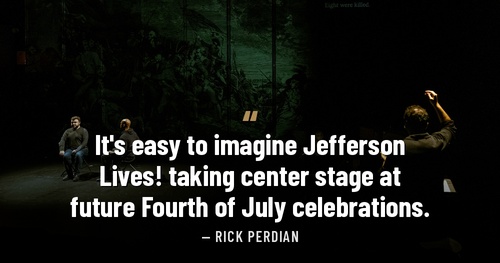
Jefferson Lives! doesn’t resolve Adams’ unease or his struggle to fully understand what the fight for independence means. The piece ends in mid-thought, with Adams acknowledging that there was no turning back after Lexington and Concord. Yet despite its intellectual and musical depth, the work remains accessible and entertaining. It’s easy to imagine Jefferson Lives! taking center stage at future Fourth of July celebrations.
Nichols’ opera was followed by Puccini’s Suor Angelica — the second opera in the composer’s Il Trittico — an unlikely pairing, perhaps, but Koroneos posits that the two works share an interest in what it means to seek freedom within systems larger than oneself. For the colonists, that meant an empire tightening its grip; for an unwed mother, an unforgiving, moralistic social structure and a convent demanding obedience.
In Koroneos’ staging, Angelica’s unkempt bed suggested an insane asylum more than the tidiness of a convent. Clearly, the Mother Superior’s strict discipline stopped at her door. Projections of fields evoked lost freedom, images of angelic boys heightened the heartbreak, and blurred images of nuns in their habits suggested the depersonalization of convent life. Most disturbing was the image of a novice dressed entirely in white, curled up in the fetal position. Koroneos’ surest directorial stroke was the explosion of flower petals as Angelica experienced a vision of divine forgiveness and redemption in the opera’s final moments.
Kristina Shafranski’s Angelica simmered with fury over being separated from her son at birth and having no news of him, or anything else, for seven years. Her vibrant, throbbing soprano captured Angelica’s rage and vulnerability with equal ease, although defiance seemed her natural suit. Her “Senza mamma,” in which Angelica laments the loss of a son who never knew his mother, was heartbreaking. Even if the final “amor” was strangled rather than floated, Angelica’s anguish was unmistakable.
As her aunt, the Principessa, Hilary Baboukis chilled the atmosphere with her denunciation of her niece for disgracing the family. Baboukis’ voice was an even, dark column of sound, with cavernous chest tones that lent full force to her fury. She imparted the news that Angelica’s son had died with stunning directness.
Sarah Pajonas’ Mother Abbess was cut from similar emotional cloth, although her voice was of a more human scale. The nun was unbending, unlike Baboukis’ Principessa, who, for one fleeting moment, revealed a heartbeat beneath her impenetrable exterior. The warmth of Xinran Du’s Suor Genovieffa radiated through both her voice and her manner, a reminder that compassion could survive within the convent.
As an ensemble, the women brought a beautifully blended sound to the daily prayers. During their midday meal, their voices sparkled as they conversed and exchanged news. In the final scenes, they entered the stage as a silent Greek chorus, their eerie movements as unsettling as the abstract line of nuns in black projected above them, presiding over the tragedy.
With only 13 players and none of the spatial effects Puccini envisioned, Alfieri nonetheless captured the tragedy’s emotional essence. The strings sent the melodies soaring, while the keyboard produced church bells and other atmospheric touches. Ultimately, though, a mother’s anguish upon discovering that the child taken from her at birth has died claims an emotional force that, particularly in Puccini’s hands, even the most stirring historical narrative cannot match.
— Rick Perdian