From Opening Night Online: Liberty in Two Keys: Teatro Grattacielo’s Double Billing at The Flea
A particular electricity arrives only when a small room is overfull. On Saturday afternoon at The Sam at The Flea Theater, staff were still conjuring extra chairs for latecomers as the lights dimmed, and the sold-out house leaned forward like a single listener. Teatro Grattacielo, New York’s indefatigable “skyscraper theater,” now in its 32nd season, had promised an America 250 double bill about freedom. What it delivered was rarer still: an argument about liberty in two keys, one public and brassy with history, the other private and luminous with grief.
At first, the pairing seems unlikely. A new work tracing the road to Lexington and Concord, then Puccini ’s convent tragedy, side by side. But as the music begins, its sense emerges, quiet and certain, like a key gliding beneath the hand. Both pieces ask what it means to reach for freedom within walls that do not yield. The empire’s grip, the convent’s hush—each presses inward, and the struggle moves inward as well, until the conscience itself becomes the ground on which everything is fought.
Jefferson Lives!: A Nation Argues Itself into Being
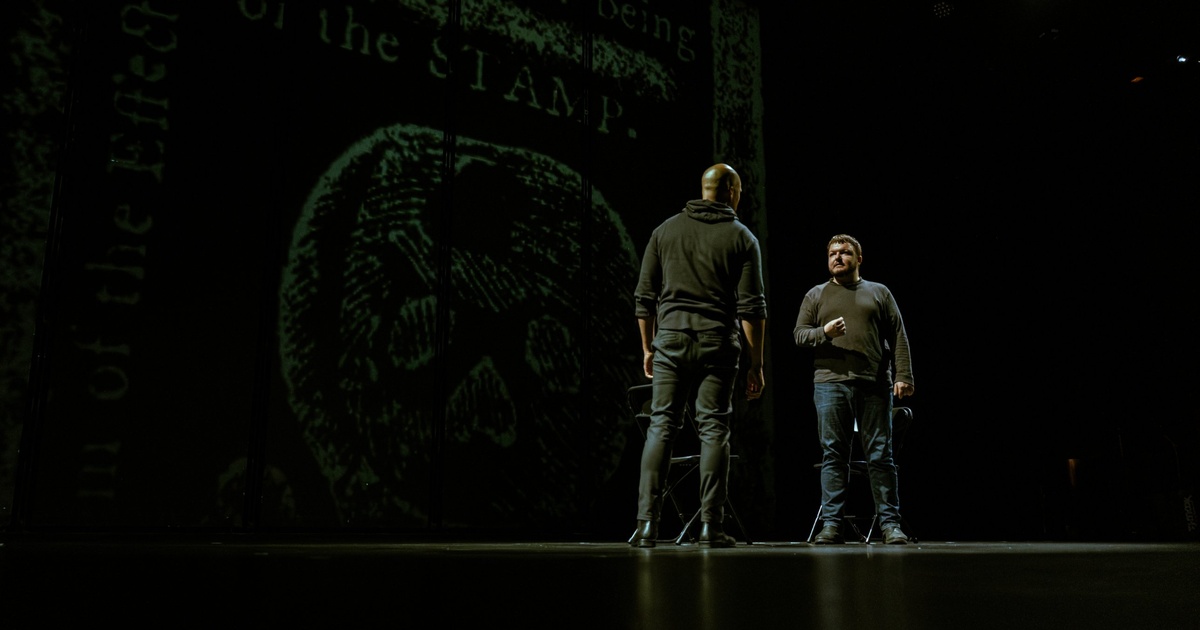
Co-commissioned with the Tucson-based collective Polyhymnia and supported by the National Endowment for the Arts through its Freedom 250 programming, Jefferson Lives! sets music by Joshua Daniel Nichols to a libretto by Stefanos Koroneos, based on the concept and reference text of James R. Harrigan. The title borrows the dying words long attributed to John Adams on July 4, 1826, words spoken, with exquisite historical irony, hours after Thomas Jefferson had died. Jefferson never appears. Instead, the ghost of Adams keeps vigil over a modern Narrator who wakes from a troubled dream and is pulled, protesting, through eleven scenes: the Writs of Assistance, the Stamp Act, the Boston Massacre, the burning of the Gaspee, the Tea Party, and, at last, the skirmishes at Lexington and Concord.
A Score That Remembers Rather Than Reenacts
With the composer and librettist present, their intentions lingered, audible in the careful scaffolding of Nichols’s score. His language is tonal, colored by the warmth of chromatic shadows and the cool edge of modal light. Revolutionary melodies drift through the music, surfacing, slipping away, and returning altered. The quintet —flute, clarinet, violin, cello, piano—spoke in lean, sharp phrases, the sound pared down to its essentials. Traces of Stravinsky, Copland, Walker, and Blitzstein fluttered on the edges, but the piece stood in its own weather, earning its place among them.
Most striking is how the opera turns from celebration. No fireworks, only a serenade in shadow and the hush that follows a door drawn shut. The revolution has begun, and the air is charged with what cannot be undone. It is an ending that persists, sober and adult, more moving for its restraint.
Narrator and Ghost
Peterson Townsend, with a style that settles easily into the room, draws the Narrator as both wry and reluctant, drawn step by step into the story’s undertow. Across from him, Brian Jeffers’s tenor gives Adams a keen-edged, restless presence, with conscience pressing through every phrase. Their conversation, stretched over ages, becomes the pulse of the piece. At times, the projected words take over, the documents speaking in their own chill ink, the air briefly emptied of breath.
Suor Angelica: Memory, Mercy, and a Single Bed
After intermission, Giacomo Puccini’s Suor Angelica, the central panel of Il trittico (1918), with a libretto by Giovacchino Forzano, tells the story of a young noblewoman cloistered for seven years after bearing a child out of wedlock. Her aunt, the icy Princess, arrives to obtain a signature and, almost in passing, reveals that the boy died two years earlier. Angelica’s despair, her fatal draught of herbs, and her final plea for mercy dissolve into a vision of the Virgin bearing her son.
Koroneos’s staging lets the hallucination seep through the entire hour, not just the end. Everything is black and white. Angelica lies in a bed that does not move, the lone anchor in a sphere where ghosts return and vanish. Sisters, the abbess, the aunt, the lost child—they drift in from the edges, half-seen, half-remembered. The evening gathers around these haunted rooms, the same territory from which Adams stepped not long before. The past, once more, will not be kept at bay.
Now the ensemble expands to thirteen, and Puccini’s vivid, rich palette, pared down by Francisco Miranda, unfolds in the small space. The harp threads its pale gold through the air, the strings glow, the winds sigh like faraway fields, and the percussion waits, silent, for the moment when everything shivers.
The Voices of the Convent
Soprano Shannon McAleb carried the title role with radiant sincerity, her sparkling upper register perfectly suited to “Senza mamma,” where Puccini asks the heart to break in a whisper. As La zia principessa, mezzo-soprano Melina Jaharis brought the dark, resonant colors that have long made them a Grattacielo favorite, transforming the aunt’s glacial interview into genuine terror. Sarah Pajonas, Silvana Chu, and Monica Camafreita shaped the convent’s order—devotion and discipline layered in their voices. Mia Farinelli’s Genovieffa, bright as a bell; Charly Rentz’s Osmina; Meredith Hart’s Dolcina and Novice; Daniela Reyes’s Nursing Sister; Catherine McClure and Eugenia Forteza as alms collectors and lay sisters—all these voices wove a tapestry of sisterhood: gentle, chattering, and, at last, ghostly. On Sunday, Kristina Shafranski and Hilary Baboukis will step into the roles of Angelica and the Princess.
The Creative Team Behind the Magic
Credit moves outward, circling the room. Koroneos, both general and artistic director, shapes the evening with a confident hand. Camilla Tassi ’s projections spill across the back wall, transforming broadsides and cloisters into landscapes that sparkle and shift. Supertitles run quietly above, keeping every ear close. Amara McNeil’s lighting draws faces from the shadows; Angela Huff’s costumes let two centuries stand side by side. Behind the scenes, David Santiago, Fred Santambrogio, Mai Camara, Ansley Jackson, and Sergey Iorov keep the machinery breathing. The partnership with Camerata Bardi Vocal Academy brings young voices into the light, making the company’s promise visible.
Why This Double Bill Matters
Opera at this scale in this city seems like a small miracle. In the black box, with every seat close to the stage, Teatro Grattacielo delivered what grand opera promises—drama, music, costume, light—without the usual remove. You could watch a tear gather and hear the breath before a phrase. Leaving, you carried with you the odd kinship between a Boston lawyer and a dying nun: two lives, each choosing, at great cost, to let conscience speak louder than command.
— Edward A. Kliszus