From The National Herald: Success for Koroneos & Teatro Grattacielo’s Encounter between U.S. History & Puccini
The Teatro Grattacielo production, directed by the distinguished Greek-American stage director Stefanos Koroneos, was a major success, attracting a large audience to The Sam, the intimate black-box performance space of The Flea Theater in Manhattan’s TriBeCa neighborhood, for its two exclusive performances on November 7. The evening brought together two seemingly contrasting works, Joshua Daniel Nichols’ Jefferson Lives! and Giacomo Puccini’s Suor Angelica, in an ambitious artistic proposition that ultimately revealed a compelling common thread: the struggle for freedom and the human cost of its absence.
The juxtaposition of these works might initially seem an improbable theatrical proposition. One looks towards the birth of a nation; the other descends into the private devastation of a woman whose life has been shaped by social judgment and familial cruelty. Yet Teatro Grattacielo, under the artistic and general direction of Koroneos, discovers an unexpectedly persuasive connection between them.
In Jefferson Lives!, Nichols and librettist Koroneos approach the American Revolution not as a sequence of familiar historical landmarks, but as an unfolding argument about political responsibility. Through an imagined dialogue between John Adams and a contemporary narrator, the work revisits the gradual transformation of colonial discontent into revolutionary action. Its eleven sections move from constitutional grievances and taxation to the Boston Tea Party and the confrontations at Lexington and Concord. History becomes not a recitation of established facts, but a question addressed directly to the present.
Nichols demonstrates a particularly sensitive instinct for the relationship between music and language. Colonial musical references emerge within a contemporary harmonic vocabulary, giving the score a historical resonance without reducing it to pastiche. His writing is at its most effective when the instrumental ensemble reinforces the vocal line, intensifying Adams’ declarations without overwhelming the clarity of the text. The combination of violin, cello, flute, clarinet and piano creates a compact but expressive musical world, in which the flute and clarinet contribute much of the score’s distinctive color.
Brian Jeffers gives Adams vocal authority and admirable textual precision. His performance avoids unnecessary rhetorical excess, allowing the character’s convictions to emerge through the force of the music and the directness of the words. Peterson Townsend, as the Narrator, provides an effective contemporary counterpoint. His curiosity gradually acquires a more unsettled emotional dimension, suggesting that the discovery of history is also an encounter with uncomfortable questions about the present. Koroneos’ direction is commendably economical. Projections, portraits and historical documents establish the setting without competing with the central dramatic exchange.
The production does not attempt to resolve the contradictions inherent in the American experiment. This restraint is one of its strengths. Jefferson Lives! ends with the historical struggle still reverberating, leaving the audience to consider whether the principles that inspired independence have retained their original urgency.
With ‘Suor Angelica’, the evening moves from the public language of revolution to the intimate vocabulary of suffering. The connection is more profound than a simple thematic parallel. Angelica’s imprisonment is psychological, social and moral. Her tragedy arises from a world in which family honor and institutional authority are permitted to take precedence over individual compassion.
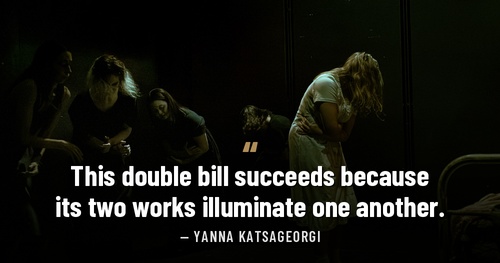
Koroneos’ staging gives this world a disturbing psychological texture. The disorderly bed, the evocative projections of open fields and the ghostly images of the nuns suggest a convent in which spiritual refuge has become inseparable from confinement. Particularly unsettling is the image of a novice curled into a fetal position, a visual expression of vulnerability that deepens the production’s atmosphere of repression. The final shower of flower petals, accompanying Angelica’s vision of forgiveness, offers a moment of theatrical beauty whose emotional effectiveness depends upon the darkness that precedes it.
Kristina Shafranski’s Angelica is the dramatic centre of the production. Her vibrant soprano conveys both the character’s defiance and her profound emotional fragility. In “Senza mamma”, she finds the essential tragedy of the role: not simply the loss of a child, but the unbearable knowledge that he never knew his mother. Hilary Baboukis makes a formidable Principessa, her dark vocal color and uncompromising dramatic authority giving the confrontation its necessary severity. The contrast between the two women is particularly effective because neither character is reduced to a theatrical stereotype.
The ensemble of nuns also deserves recognition. Their blended sound in the communal prayers and their more animated exchanges during the midday meal establish a convincing collective identity, while their silent presence in the final scenes lends the tragedy an almost ritualistic dimension.
Saverio Alfieri conducts the reduced instrumental forces with sensitivity to Puccini’s dramatic architecture. Although the smaller ensemble cannot reproduce the full richness of the composer’s orchestral palette, it preserves the essential melodic and emotional trajectory of the score.
Ultimately, this double bill succeeds because its two works illuminate one another without losing their individuality. ‘Jefferson Lives!’ considers freedom as a collective political achievement; ‘Suor Angelica’ reveals what happens when individual freedom is sacrificed to the demands of an unforgiving social order. Their encounter suggests that the meaning of liberty cannot be measured solely by historical victories or political declarations. It must also be judged by the dignity, compassion and humanity afforded to the individual.
That is the evening’s most lasting achievement. Teatro Grattacielo offers not merely an unusual operatic pairing, but a thoughtful reminder that freedom is meaningful only when it belongs to everyone.
— Yanna Katsageorgi