
“Joseph Summer’s ‘The Tempest’ is not merely another musical setting of Shakespeare; it is a production that demonstrates contemporary opera’s continuing ability to tell stories with emotional depth, artistic integrity, and aesthetic coherence.”
— Yanna Katsageorgi
From The National Herald:
Two performances, on July 16 and 18, were enough to demonstrate that Joseph Summer’s ‘The Tempest’ is far more than another operatic adaptation of Shakespeare. It is a fully realized work of music theatre. At La MaMa, New York’s historic Off-Off-Broadway landmark, Teatro Grattacielo, guided by its Artistic Director Stefanos Koroneos, who also directed the production, presented an interpretation that affirmed the enduring vitality of Shakespeare when a director allows the text to breathe rather than overshadowing it with concept.
Translating Shakespeare into opera without sacrificing either the poetry of the language or the dramatic intensity of the play is no easy task. Joseph Summer avoids that trap. Rather than using music as a vehicle for spectacle, he allows it to emerge naturally from the drama. The melodic lines follow the cadence of Shakespeare’s language, the vocal writing serves the characters, and the score becomes a vehicle for emotion rather than an end in itself. Instead of overwhelming Shakespeare, the opera enters into a genuine dialogue with him.
The story remains faithful to its essential core. Prospero, exiled and betrayed, uses his knowledge and power to confront his enemies with the consequences of their past, only to choose forgiveness over revenge. This journey, from anger to reconciliation, forms the emotional heart of the opera, and it is conveyed here with remarkable sensitivity.
Eve Summer’s libretto respects the internal rhythm of Shakespeare’s text without becoming constrained by literal fidelity. It preserves the poetic atmosphere while allowing the music to develop its own dramatic voice. The result is a rare balance between word and sound, particularly valuable at a time when contemporary opera too often favors theatrical effect over dramatic substance.
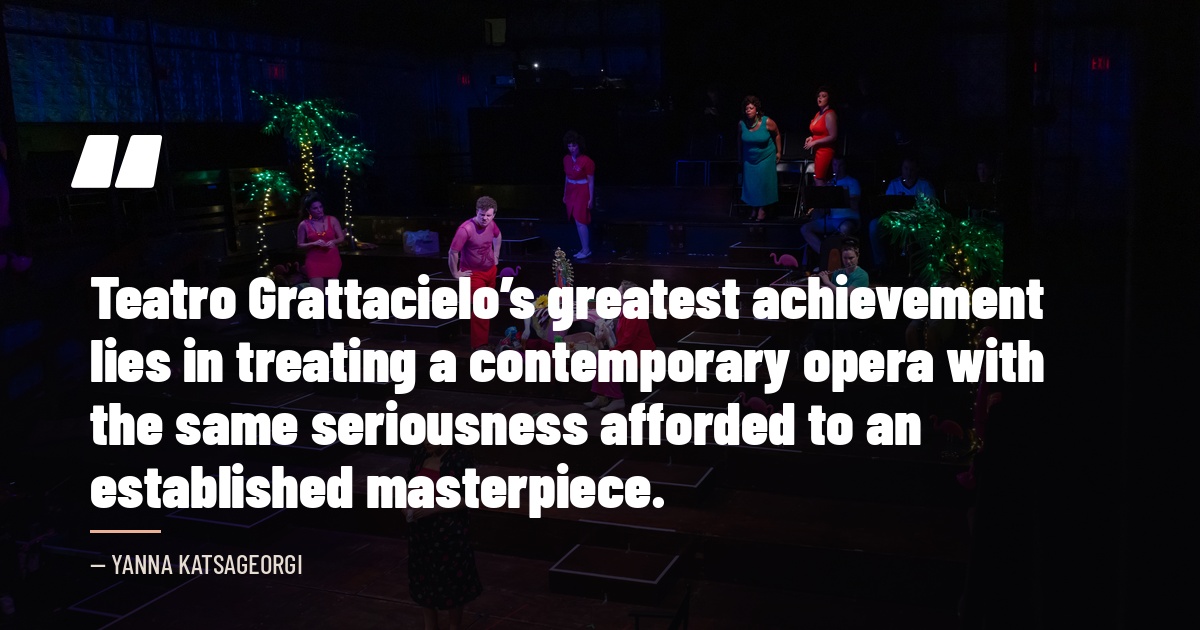
A defining element of the production is Stefanos Koroneos’ direction. With both imagination and restraint, he relocates the action to an abandoned film studio of the 1980s, a liminal space where memory, imagination, and reality coexist. The scenery, projections, and lighting create a world suspended between dream and recollection without ever distracting from the performers themselves. Koroneos never imposes himself upon the work; instead, he serves it. He allows the music room to breathe while giving the singers the space to develop authentic dramatic relationships. The result is a production with an almost cinematic rhythm, where every image has purpose and every silence carries meaning.
In the pit, Enrico Fagone conducts with confidence, elegance, and admirable restraint. The orchestra never competes with the voices; instead, it supports, illuminates, and accompanies them with a balance that moves the audience without resorting to excess.
Daniel Klein delivers a compelling Prospero whose authority springs from inner strength rather than theatrical grandeur. His mature and composed interpretation gives convincing shape to the character’s journey toward forgiveness. Kayla Viviana brings an ethereal presence to Ariel, combining a luminous voice with remarkable vocal agility. Sara Kennedy and Omar Najmi form a warm and expressive Miranda and Ferdinand, while Benjamin Sieverding offers a deeply human Caliban, investing the role with emotional complexity and dignity. The remaining cast, including Eleanna Finokalioti as Calypso, performs with admirable cohesion, reflecting the careful preparation that characterizes the production as a whole.
Teatro Grattacielo’s greatest achievement lies in treating a contemporary opera with the same seriousness afforded to an established masterpiece. Joseph Summer’s ‘The Tempest’ is not merely another musical setting of Shakespeare; it is a production that demonstrates contemporary opera’s continuing ability to tell stories with emotional depth, artistic integrity, and aesthetic coherence.
It reminds us that Shakespeare remains timeless not because we continually reinvent him, but because he continues to teach us how to listen to ourselves. When opera resists self-indulgent grandeur, it transforms memory into a creative force, giving it the expressive means to engage with the future. Leaving the theater, one carries away not only the memory of an accomplished production, but also the reassuring conviction that theater still possesses the power to confront us with our own humanity.
– Yanna Katsageorgi